
Off-Page SEO Submission List In 2026
What Is Off-Page SEO?
Let’s give you a quick overview of off-page SEO and its differences from on-page SEO before we get into the main topic. This will make it much easier for you to understand the material we have covered here.
All of the external efforts that raise your website’s position on search engine results pages (SERPs) are collectively referred to as off-page SEO. Third-party websites that directly link to or discuss your pages are referred to as external activity. As a result, there are no mentions or links on your website.
Are Link Building and Off-Page SEO the Same Thing?
Many people use off-page SEO and link building interchangeably because they think they are the same thing. However, despite what many people think, these two are not the same because off-page SEO is much more than simply getting backlinks from other websites. This technique does include obtaining backlinks from high-authority websites, but it is not the sole factor influencing off-page SEO success.
Maintaining the quality of the material on your website is a necessity if you want to keep people interested. Consider it a form of word-of-mouth advertising that is frequently used in offline, physical company situations.
When your material is good, people will naturally promote it for you, which will give you a significant edge over rivals. Search engine algorithms pay attention when there is positive conversation about your website and its content, which raises your ranks.
As we’ve covered in the next section, there are a number of additional aspects that affect how well your off-page SEO approach works.
Off page SEO List of Submissions for 2026
How to Generate Backlinks via Each Submission Type
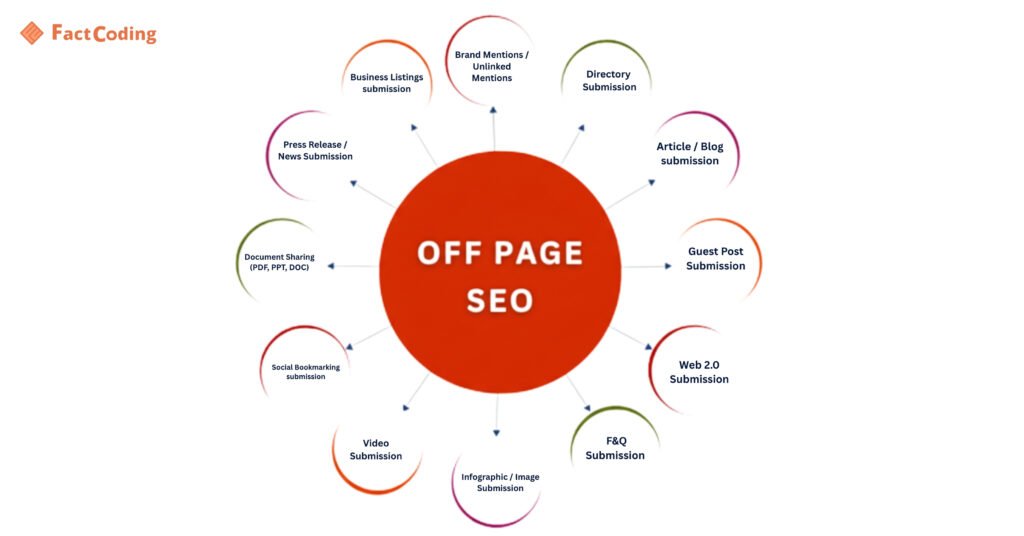
Below are strategies for each major submission type to generate real value backlinks (not just low-quality ones).
Directory Submission
- Choose niche-specific, high-quality directories (avoid generic low-quality ones).
- Ensure your NAP (Name, Address, Phone) and site info is accurate (for local SEO).
- Use a mix of dofollow and nofollow, but prioritize directories with dofollow authority.
- Submit in appropriate categories, with relevant anchor text.
Article / Blog / Guest Post Submission
- Write in-depth, valuable content that other sites would want to link to.
- Use within-content anchor text links (with primary/secondary keywords) back to your targeted pages.
- Leverage high-authority blogs in your niche for guest posting.
- At the end, include a brief author bio linking to your site.
Web 2.0 Submission
- Create property (e.g. on WordPress.com, Blogger, Medium, etc.) and publish content linked to your main site.
- Ensure uniqueness (don’t duplicate full content), add images, internal links, social shareable elements.
Use these web 2.0 pages to funnel authority.
Forum / Q&A / F&Q Submission
- Participate in relevant niche forums or Q&A platforms (Quora, StackExchange, niche forums).
- Provide useful, non-spammy answers. Include relevant links when helpful.
- Use branded anchor text or natural anchors.
Infographic / Image Submission
- Design high-quality infographic or visuals relevant to your niche.
- Publish it on infographic submission portals, image sharing sites, and allow embed code for others to share (with a backlink).
- Optimize alt text and description with keywords.
Video Submission
- Create videos (tutorials, explainers) and upload to YouTube, Vimeo, Dailymotion.
- Include your website URL in descriptions and in video cards.
- Add transcripts or captions so search engines parse content.
Bookmarking / Social Bookmarking
- Use high-authority social bookmarking sites (e.g. Reddit, Pinterest, some bookmarking networks) to bookmark your content.
- Use relevant titles, descriptions, tags.
- Don’t overdo — avoid spammy bookmarking networks.
Document Sharing (PDF, PPT, DOC)
- Create useful documents (whitepapers, case studies) and upload to sites like SlideShare, Scribd, Academia.edu, etc.
- Within these docs, embed links to your main site.
- Use keyword-rich titles, descriptions, tags.
Press Release / News Submission
- Write newsworthy press releases (product launches, awards, studies) and distribute via PR networks.
- Use one or two backlinks in the release (with anchor text).
- Ensure the PR site is reputable.
Local Citations / Business Listings
- Submit your business to local directories, niche business listings, local chambers, maps, etc.
- Keep NAP consistency across all listings.
- Add description, images, website link.
Brand Mentions / Unlinked Mentions
- Use PR, influencer outreach, interviews, podcasts to get your brand mentioned (even without links).
- Later, reach out to convert unlinked mentions into backlinks.
How Can You Improve Your Off-Page SEO in 2026?
To boost your rankings and brand visibility, focus on these key off-page SEO techniques:
1. Build Quality Backlinks
Earn links from high-authority and relevant websites. Use broken-link building, guest posting, and content outreach to create natural backlinks.
2. Strengthen Brand Presence
Run brand-awareness campaigns and collaborate with niche websites to get more mentions and trust signals for FactCoding.
3. Leverage Influencer Marketing
Partner with influencers in your niche to increase reach, drive organic traffic, and improve brand credibility.
4. Stay Active on Social Media
Post regularly on platforms like LinkedIn, Instagram, and YouTube. Share blog links and engage with users to boost visibility and referral traffic.
5. Optimize Google Business Profile
Maintain accurate NAP details, add reviews, and post updates to improve local rankings and trust.
6. Join Forums & Communities
Engage in platforms like Quora or Reddit. Provide helpful insights and share your expertise to increase brand authority.
7. Use Content Marketing
Create shareable assets—blogs, infographics, and reports—to attract backlinks and mentions naturally.
8. Boost Digital PR
Get featured on high-authority blogs or news sites to build strong trust signals and referral traffic.
What Are the Differences Between On-Page and Off-Page SEO?
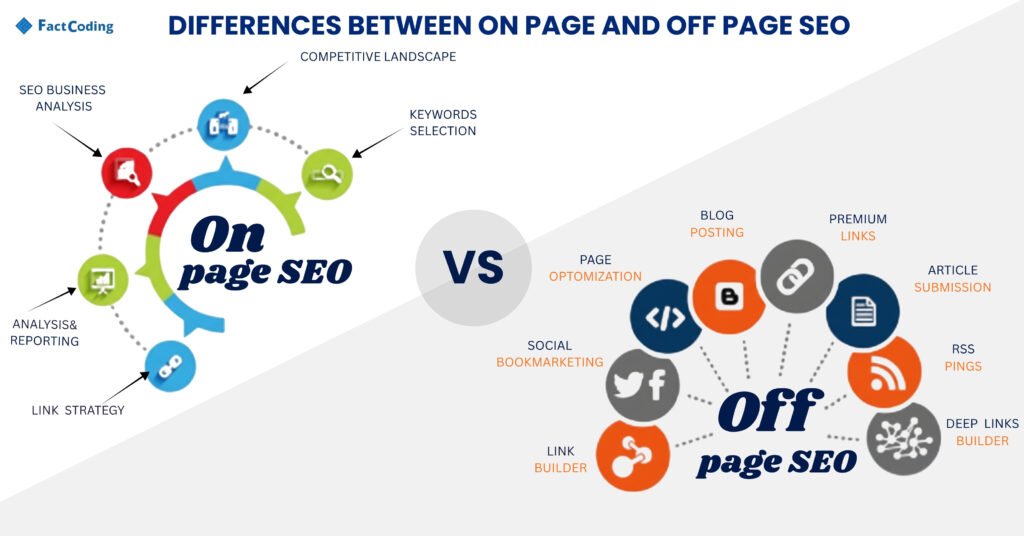
After reviewing the material above, what distinguishes off-page SEO from on-page SEO? The primary distinction is that off-page SEO list in 2026 refers to the activities performed on all other websites than your own, and on-page SEO is done exclusively on your website.
As a result, the elements influencing on-page SEO success are quite different from those influencing off-page SEO. They put more of an emphasis on developing your website than on increasing brand recognition and inbound links.
In order to maintain user engagement, you must make sure that your on-page content is engaging and pertinent. Similarly, in order for consumers to find your website appealing, you need to focus on its overall appearance and feel.
Closing remarks
In 2026, enhancing your off-page SEO requires concentrating on real digital growth rather than taking short routes.
The trust score of your website is influenced by each link, mention, and share.
FactCoding is able to develop a robust, future-proof off-page SEO plan that increases visibility, establishes authority, and ranks higher on Google by integrating PR, influencer connections, social engagement, and link building.
